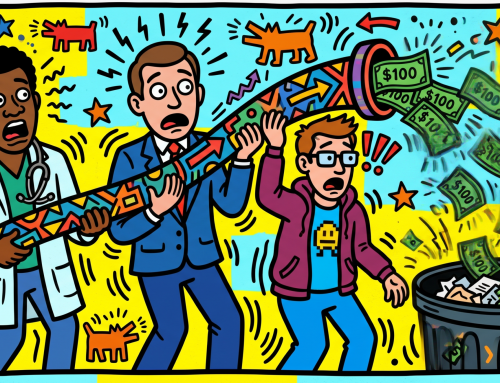

How to Crush a Provider’s Soul, One Click at a Time
Davita’s left leg was fidgeting nervously as Dr. Anapol was, once again, fussing with her computer. Davita came to the clinic to talk about a personal health issue, not to watch the doctor direct all her attention at a machine.
Dr. Anapol could feel the frustration building in the exam room. But there was little she could do. Last night, IT pushed an update that rearranged the layout of her dashboard and added options unfamiliar to Dr. Anapol. Glancing under the desk, she could see Davita’s leg fidgeting.
As she made the final click in this cumbersome workflow, Dr. Anapol let out a disappointed sigh and turned her attention back to Davita, “OK, let’s start over from the beginning…”
The Two Halves of Value
In healthcare operations, when a provider sighs, it’s a clear sign of an unbalanced value equation. Most COOs and CFOs focus on the tangible side of the value equation. It’s easier to model how a new technology might reduce costs, increase revenue or expand clinical capacity. These metrics are comfortable because they directly impact the bottom line and fit neatly into a quarterly report.
While these metrics are vital to the business model, they represent one half of the value equation. The other half consists of intangible benefits, the human factors that dictate technology usage, provider satisfaction and patient retention. When a solution ignores these variables, it fails to earn adoption, regardless of what your financial model predicted.
Why a Focus on Tangible Benefits Often Fails
In the scenario above, I’m certain that IT and informatics checked every box in the project plan. They deployed a solution that satisfied all the business requirements and would deliver all the tangible benefits that were modeled in a spreadsheet.
Yet, the update, and its accompanying user experience (UX), failed to provide any intangible benefits to the provider or the patient. In fact, the update degraded the provider-patient experience by increasing the stress, frustration and anxiety felt by Davita and Dr. Anapol.
It doesn’t have to be this way. Alan Cooper, a pioneer in UX design, says the goal of a software-enabled solution is to create delight – a feeling of joy, surprise or satisfaction – as users interact with a solution that solves their problems in a way that is both elegant and intuitive.
A well-designed UX enables providers to deliver excellent care to their patients. A poorly-designed UX adds undue burdens to providers and distracts them from being present with patients. If your tools crush the souls of your providers a tiny bit with every interaction, you’ve got a problem.
Three Questions to Uncover Intangible Benefits
The next time you invest in new technology or update your existing technology, ask questions to uncover the intangible benefits. In addition to the tangible benefits…
- Does this technology decrease fear, anxiety and/or frustration in my providers and their patients?
- Does this technology increase their confidence, satisfaction and/or ability to work at the top of their license?
- If so, how?
Reducing a provider’s cognitive load is not a soft objective when updating your workflows. It’s a business requirement that secures tangible results.
If your technology updates are checking boxes but failing in your clinics, let’s talk. Schedule a discovery call to rebalance your value equation and restore focus on your providers.