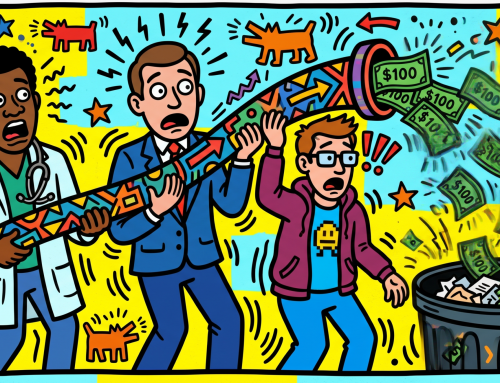

Are Your Ambulatory Surgery Center Profits Trapped in a Slow Moving DMV Queue?
Attention COO and CFO at ambulatory surgical centers, does it feel like your IT team is managing EHR optimizations like the waiting room at the DMV?
The first sign something might be up is when your monthly surgical case volume is high, but your end-of-month revenue is flat. After a few conversations with clinicians, you discover that high-acuity perioperative care was not fully captured by the EHR.
Use the Five Whys to Uncover the Facts
After digging a little deeper, here’s what really happened…
- Why did the EHR fail to capture the level of care?…Because the clinicians were using out-of-date templates.
- And why were the templates out-of-date?… Because the update to the acuity recapture logic sat at the bottom of the backlog.
- And why did that happen?… Because the IT team has prioritized making cosmetic updates to the patient portal over updating templates.
- And why were they working on the patient portal?… Because the IT manager responsible for the backlog prioritized it using first-in, first-out logic.
The IT manager ordered the backlog like the line at the DMV and the business paid the price.
Steering Committees Reinforce Silos, Not Break Them
For many COO and CFO, the common response to this scenario would be to implement a monthly steering committee to review, and approve, every ticket in the backlog. That is a common mistake.
This only adds non-value added administrative work that reinforces your silos. You cannot fix a broken intake process with more meetings. Adding executive signoff to minor technical tasks only compounds the delays.
Prioritize Using Cost of Delay
The solution is to stop prioritizing your optimization backlog based on arrival time and start prioritizing your optimizations based on the cost of delay. Cost of delay ensures that revenue critical optimizations, like those enabling high acuity care to be accurately captured, automatically bypass the maintenance noise.
When your optimization backlog is treated as a series of core product enhancements instead of a list of support tickets, your IT investments finally align with your EBITDA goals. The result: a responsive infrastructure where high-value clinical workflows are prioritized by design, not by permission.
How long are you willing to tolerate ineffective trial-and-error “fixes”?
Contact me if you’re eager to explore how changes in your IT intake processes can help slow the linear growth in operational costs. I can help.